
Fasting Training
Pair Fasting with Productivity, Workouts, and Clear Thinking
Fasting isn’t just about when you eat, it’s about how your energy, focus, and training adapt when you give your body a consistent rhythm. With the right adjustments, fasting can support both mental clarity and physical performance.
Inspired By:
Mattson, Panda, Longo, Ohsumi, Huberman, Hyman, Berg, Winter, Seyfried
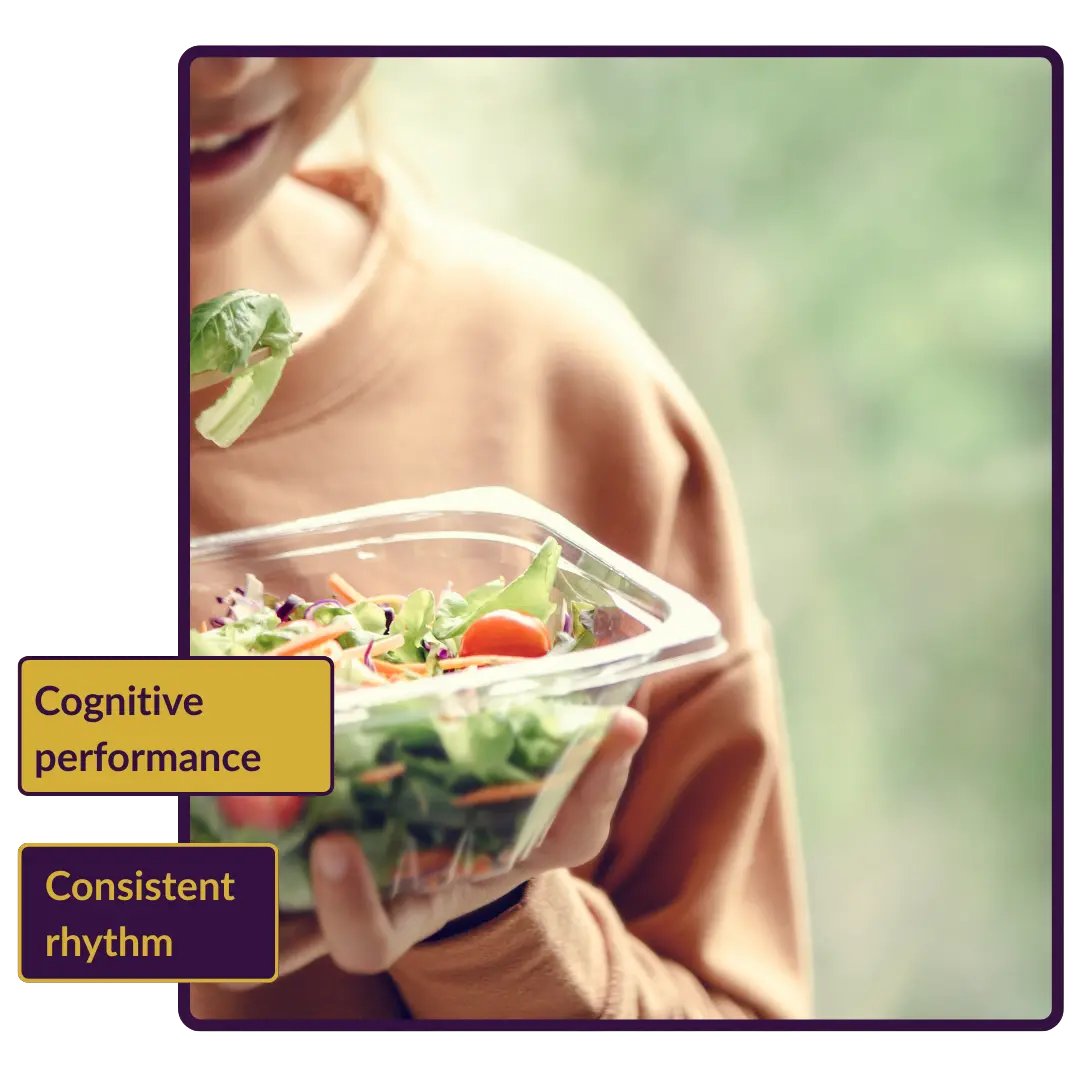
Work & Cognition
Many people notice steadier focus during fasting hours, free from the dips and spikes that often come with constant snacking.
Others may take a few weeks to adjust.
The best way to understand your response is to track your focus and energy for 2–3 weeks. Pay attention to your most productive hours and align your eating window accordingly.
Research Insight:
Neuroscientist Andrew Huberman highlights that aligning your feeding with circadian rhythms, eating earlier and keeping windows consistent can support cognitive performance and mood.
Training Placement
Your workouts don’t need to suffer while fasting. In fact, with a few adjustments, they can improve:
Strength & High-Intensity Training (HIIT)
Best scheduled near the start of your eating window, so you can refuel with protein and nutrients soon after.
Low-to-Moderate Cardio
Activities like walking, cycling, or light jogging can be done fasted—just stay hydrated and listen to your body.
Recovery
Sleep is still the foundation of progress. Aim for 7–9 hours each night to support muscle repair, mental clarity, and hormonal balance.
The NovareVitalis™ Weekly Matrix
A simple framework you can adapt to your own life:
Weekly Framework
- Monday / Wednesday / Friday → Strength or HIIT sessions inside your eating window
- Tuesday / Thursday → Easy fasted walk or light cardio
- Weekend → Flexible—choose what works best for your schedule and recovery
This rhythm balances training stress with fasting benefits while keeping your week realistic and adaptable.
The Fasting Treasure No where to found
IF + Exercise: How to Program Cardio, Lifting, and Recovery
Intermittent fasting (IF) isn’t a training plan—but the way you train inside a fasting schedule matters. Done right, you can lift heavy, run faster, keep (or gain) lean mass, and use your fasting window as a compliance tool to manage hunger and calories—not as a limit on performance.
What happens to training in a fast?
During a fast, insulin is low (unlocking fat stores), norepinephrine rises (mobilizing fat), and growth hormone increases (lean-mass sparing) (de Cabo & Mattson, 2019). Ketones provide steady fuel for the brain, so you can focus, and your body becomes more metabolically flexible—better at burning fat at lower intensities. That’s why many people feel great doing steady cardio or skill work in a fast. For high-intensity work or heavy lifting, glycogen still matters—so you’ll either (a) train fasted and eat soon after, or (b) train within your eating window.
Lifting + IF: the research
In resistance-trained men, an 8-hour eating window (16:8) over 8 weeks produced fat loss without loss of muscle or strength (Moro et al., 2016). Reviews find IF can preserve lean mass as well as continuous diets when protein and progressive resistance training are in place (Tinsley & La Bounty, 2015). Translation: you can lift heavy and keep muscle on IF if you hit protein and total calories.
Cardio + IF: “train low,” race high
For submaximal cardio, a fasted session nudges your body to oxidize more fat (Hawley & Burke, 2010). That doesn’t mean every session should be fasted; it means you can place easy/steady work when fasted to develop fat-burning capacity, then fuel harder intervals or key long runs inside the eating window.
Programming templates (pick one)
A) Strength-biased (4 days/week lifting)
Mon/Thu (fasted AM or pre-lunch): Squat/hinge focus; break fast within 1–2 h post-lift (30–50 g protein + carbs).
Tue (easy cardio/skills): 30–40 min steady; hydrate + electrolytes.
Sat (upper push/pull): Train at start of eating window; normal meals after.
B) Endurance-biased (2–3 lifts + intervals)
Mon/Wed/Fri: 30–60 min steady cardio fasted; optional strides at end.
Tue/Sat: Lift at first meal; add intervals (e.g., 6×3 min @ 5K effort) within window.
Long run/ride: Place in window; pre-fuel lightly (banana/yogurt), eat protein-carb meal after.
C) General fitness (3 lifts + 2 mixed cardio)
Mon/Wed/Fri: Full-body lifting (compound push/pull/hinge/squat).
Tue/Sat: 20–30 min zone 2 + 6–8 hill sprints or short intervals (do inside window if intensity is high).
Protein, carbs, and total calories
Protein: Aim for 1.6–2.2 g/kg/day (Morton et al., 2018), split over 2–3 feedings ≥25–40 g each to maximize muscle protein synthesis.
Carbs: You don’t need to go ultra-low. Use carb periodization—cluster more carbs on lift/interval days (inside your window) and fewer on easy/rest days.
Fats: Include quality fats (olive oil, nuts, omega-3s) for satiety and recovery.
Creatine: 3–5 g/day supports strength and lean mass irrespective of timing.
Fasted training tips (so it feels good)
Hydrate; add a pinch of salt or an electrolyte tab if you cramp or eat lower-carb.
Keep fasted sessions ≤60 min if high intensity; extend easy/steady work as you adapt.
If heavy squats/deads feel flat fasted, shift them into the window or add a tiny protein-only “preload” (know it breaks a strict fast, but it can be worth it for performance).
Break the fast within ~1–2 hours after lifting with 30–50 g protein + carbs (e.g., eggs + rice, Greek yogurt + fruit, tofu bowl with quinoa).
Recovery and readiness
Sleep (7–9 hours) is your anabolic multiplier. IF often improves sleep when eating stops 2–3 h pre-bed. Track simple markers—resting heart rate, mood, bar speed—to avoid pushing intensity on under-recovered days. If you’re dragging for a week, widen the window or raise calories by ~10%.
Female athletes: cycle-aware tweaks
Many women do great with 14:10 most days; extend to 16:8 if energy, mood, and cycles are stable. In late luteal phase, slightly shorten the fast or bring carbs closer to training if sleep/cravings dip. The rule: fuel the work, protect cycles, and progress loads.
Bottom line
Use IF as a structure tool, not a limiter. Lift heavy 2–4×/week, layer easy cardio (fasted is fine), fuel key efforts in your window, and hit daily protein. Do that, and IF supports the exact adaptations you want—stronger, fitter, leaner.
Selected references
Moro T et al. Time-restricted feeding + resistance training. J Transl Med. 2016;14:290.
Tinsley GM, La Bounty PM. IF and body composition/performance. Nutr Rev. 2015;73:661–674.
Hawley JA, Burke LM. “Train-low” for endurance adaptations. Sports Med. 2010;40:1–23.
de Cabo R, Mattson MP. N Engl J Med. 2019;381:2541–2551.
Morton RW et al. Protein dose & MPS. Br J Sports Med. 2018;52:376–384.

Ready to Begin?
Start today with our free 14-Day Beginner Plan and take your first step into fasting with clarity and confidence.
COMPANY
Keep in Touch
Copyrights 2025 | Terms & Conditions
Disclaimer: The information available is for informational purpose only and not intended to diagnose, treat, cure, or prevent any disease.